Klaviyo vs Mailchimp for Shopify: Which One Actually Wins in 2026?
A detailed comparison of Klaviyo and Mailchimp for Shopify stores. We break down pricing, Shopify integration, automation, templates, SMS, and more to give you a clear winner.
TL;DR: Klaviyo vs Mailchimp for Shopify
If you're comparing Klaviyo vs Mailchimp for your Shopify store, here's the verdict: Klaviyo wins for Shopify stores that need deep e-commerce integration, advanced segmentation, and revenue-focused automation — it was built specifically for this. Mailchimp is cheaper at lower contact counts and works fine if email marketing is a small part of your business, but its Shopify integration has a rocky history that still matters in 2026. If cost predictability is your priority, a flat-rate alternative like Spoks ($35/month, unlimited contacts) is worth a serious look.
Quick Comparison: Klaviyo vs Mailchimp for Shopify
| Feature | Klaviyo | Mailchimp |
|---|---|---|
| Starting price | $20/mo (500 contacts) | ~$13/mo Standard (500 contacts) |
| Free tier | 250 contacts, 500 emails/mo | 500 contacts, 1,000 emails/mo |
| Cost at 10,000 contacts | ~$150/mo | ~$100/mo |
| Cost at 25,000 contacts | ~$400/mo | ~$270/mo |
| Shopify integration | Deep, native, purpose-built | Rebuilt after 2019 breakup |
| Email automation | Advanced, e-commerce-specific | Solid general-purpose |
| SMS marketing | Built-in (add-on cost) | Limited, add-on only |
| Templates | E-commerce focused | Broader library, less Shopify-specific |
| Analytics | Revenue attribution, predictive | Standard campaign metrics |
| Learning curve | Moderate-steep | Easy-moderate |
| Best for | Serious Shopify stores | General small business |
The Fundamental Difference: Purpose-Built vs Bolted-On
Before diving into features, you need to understand one thing that shapes every other comparison in this article: Klaviyo was built from the ground up for e-commerce. Every feature, every data model, every automation template assumes you're running an online store. Mailchimp was built as a general-purpose email marketing platform that later added e-commerce features.
This distinction matters more than any individual feature comparison. When Klaviyo shows you customer lifetime value predictions or lets you segment by predicted next order date, that's not a bolt-on feature — it's core to how the platform thinks about your data. When Mailchimp offers Shopify product blocks in emails, it's adapting a general-purpose tool to an e-commerce use case.
Neither approach is inherently better. But if you're running a Shopify store and email is a primary revenue channel, the platform that was built for your exact use case will feel different from day one.
Pricing Deep Dive: Mailchimp vs Klaviyo
Pricing is where most Shopify store owners start this comparison, so let's lay out the real numbers — including the costs that don't show up on the pricing page.
Free Tiers
Mailchimp offers the more generous free plan on paper: 500 contacts and 1,000 emails per month. However, the free plan includes Mailchimp branding on every email, limited automations (single-step only), and no A/B testing.
Klaviyo gives you 250 contacts and 500 email sends per month. The free plan is more restrictive in volume, but you get access to all of Klaviyo's core features including multi-step automations, segmentation, and the flow builder. For a small Shopify store just getting started, Klaviyo's free tier is actually more useful despite the lower limits.
Cost at Scale
| Contact Count | Klaviyo (Email) | Mailchimp (Standard) | Difference |
|---|---|---|---|
| 500 | $20/mo | ~$13/mo | Mailchimp saves $7/mo |
| 2,500 | ~$60/mo | ~$45/mo | Mailchimp saves ~$15/mo |
| 10,000 | ~$150/mo | ~$100/mo | Mailchimp saves ~$50/mo |
| 25,000 | ~$400/mo | ~$270/mo | Mailchimp saves ~$130/mo |
| 50,000 | ~$720/mo | ~$410/mo | Mailchimp saves ~$310/mo |
At every tier, Mailchimp is meaningfully cheaper. At 25,000 contacts, you'd save roughly $1,560 per year by choosing Mailchimp over Klaviyo. At 50,000 contacts, the annual savings jump past $3,700.
But these headline numbers don't tell the full story.
Hidden Costs: Where the Pricing Gets Confusing
Mailchimp's audience vs. contact confusion. Mailchimp historically charged based on "audiences" (lists), and contacts subscribed to multiple audiences counted multiple times. While Mailchimp has simplified this in recent years, the legacy of confusing billing structures remains. You also pay for unsubscribed and non-subscribed contacts on some plans unless you manually clean your list. Read the fine print carefully.
Mailchimp's feature gating. The Standard plan ($13/mo at 500 contacts) locks advanced segmentation, comparative reporting, and multivariate testing behind the Premium plan — which starts at $350/mo. Many features Shopify stores actually need are only available at the top tier.
Klaviyo's active profile billing. Klaviyo charges based on all active profiles in your account. If someone signed up three years ago and never opened an email, they still count toward your bill unless you manually suppress or delete them. This means your costs can creep up even if your engaged audience hasn't grown.
Klaviyo's SMS add-on. SMS on Klaviyo starts at $15/month extra (bundled into the Email + SMS plan at $35/mo for 500 contacts). If you're comparing Mailchimp's email-only price against Klaviyo's Email + SMS plan, make sure you're comparing apples to apples.
The Verdict on Pricing
Mailchimp is cheaper at every contact tier — sometimes significantly so. But cheaper doesn't mean better value. Mailchimp locks important e-commerce features behind expensive Premium plans, and the platform wasn't designed for the specific workflows Shopify stores rely on. If you'd need Mailchimp Premium to get the features Klaviyo includes on every paid plan, the pricing gap narrows or disappears entirely.
Shopify Integration: The History Matters
This is where the Klaviyo vs Mailchimp comparison takes a hard turn — and where Mailchimp's history becomes a real factor.
The Mailchimp-Shopify Breakup (and Why It Still Matters)
In 2019, Mailchimp and Shopify had a very public breakup. Mailchimp refused to comply with Shopify's partner requirements around data sharing and customer ownership. The integration was removed from the Shopify App Store, and tens of thousands of merchants were left scrambling for alternatives.
Mailchimp and Shopify reconciled in 2022 and the integration is back. But those three years left a mark. During the breakup, Shopify stores that depended on Mailchimp had to use clunky third-party connectors or migrate entirely. Many stores that moved to Klaviyo during that period never came back.
More importantly, those three years meant Mailchimp's Shopify integration missed a critical development window. While Klaviyo was deepening its Shopify hooks — adding Shopify Flow support, refining product recommendation engines, building predictive analytics on top of Shopify order data — Mailchimp was disconnected entirely.
Klaviyo + Shopify: Purpose-Built Integration
Klaviyo's Shopify integration is the deepest of any third-party email marketing platform:
- Real-time sync of customers, orders, products, and on-site browsing behavior
- Shopify Flow compatibility for triggering Klaviyo events from Shopify actions
- Product recommendation engine trained on your store's actual purchase data
- Segmentation by AOV, purchase frequency, product category, discount code usage, and more
- Back-in-stock and price drop automations that pull directly from your Shopify catalog
- Predictive analytics (CLV, churn risk, next order date) built on Shopify order history
Klaviyo doesn't just connect to Shopify — it thinks in Shopify's data model.
Mailchimp + Shopify: Rebuilt, But Still Catching Up
Mailchimp's rebuilt Shopify integration covers the fundamentals:
- Customer and order data sync
- Product content blocks for emails
- Purchase-based segmentation
- Abandoned cart automation
- Basic product recommendations
It works. But the depth isn't there yet. You won't find Shopify Flow support, predictive analytics built on purchase data, or the kind of granular browsing behavior tracking that Klaviyo offers. The integration feels like what it is: a reconnection after a three-year gap, not a continuous evolution.
Winner: Klaviyo
This isn't close. If Shopify integration depth matters to your business — and if you're running a Shopify store, it should — Klaviyo is the clear choice. The 2019 breakup cost Mailchimp years of development time it hasn't fully recovered.
Email Automation: Shopify-Specific Flows
Automation is where email marketing earns its revenue. Here's how Klaviyo and Mailchimp handle the flows that matter most for Shopify stores.
Abandoned Cart Recovery
Klaviyo offers multi-step abandoned cart flows with conditional branching based on cart value, customer segment, product category, and browsing history. You can send different sequences to first-time visitors vs. returning customers, or escalate from email to SMS based on cart value.
Mailchimp provides abandoned cart emails through their Customer Journey builder. The flow works, but branching logic is limited compared to Klaviyo. You can set up basic timing and conditions, but complex segmentation within the flow requires workarounds.
Winner: Klaviyo. The branching logic and Shopify data integration make Klaviyo's abandoned cart flows significantly more sophisticated.
Post-Purchase Sequences
Klaviyo excels here with flows triggered by specific product purchases, predicted next order date, review requests timed to delivery, and cross-sell sequences based on purchase history. You can build genuinely smart post-purchase experiences.
Mailchimp handles basic post-purchase emails (thank you, review request, related products) but lacks the predictive layer. You can trigger emails after purchase, but you can't easily trigger them based on when a customer is likely to reorder.
Winner: Klaviyo. The predictive analytics integration makes post-purchase sequences meaningfully better.
Browse Abandonment
Klaviyo captures detailed on-site browsing behavior through its Shopify integration — which specific products were viewed, how long the visitor spent on each page, which variants they looked at. Browse abandonment flows can be personalized to show the exact products someone viewed.
Mailchimp supports browse abandonment with more basic tracking. You'll know what products someone viewed, but the granularity and personalization depth aren't at Klaviyo's level.
Winner: Klaviyo.
Win-Back Campaigns
Klaviyo lets you trigger win-back flows based on predicted churn risk, days since last purchase, customer lifetime value, and engagement decline. You can target customers at risk of churning before they actually leave.
Mailchimp offers time-based win-back automations (send email X days after last purchase). It's straightforward but reactive — you're reaching out after the problem, not before.
Winner: Klaviyo.
Overall Automation Verdict
Klaviyo wins the automation comparison decisively. Every core Shopify flow — abandoned cart, post-purchase, browse abandonment, win-back — is more capable in Klaviyo due to deeper Shopify data integration and predictive analytics. Mailchimp's automations work fine for basic sequences, but they lack the e-commerce intelligence that makes Klaviyo flows genuinely revenue-driving.
That said, if you're running simple 2-3 step automations and don't plan to build complex branching flows, Mailchimp's Customer Journey builder is perfectly adequate and easier to set up.
Email Builder and Design
Klaviyo's Email Editor
Klaviyo's drag-and-drop editor is built for e-commerce emails. Standout features include:
- Dynamic product blocks that pull directly from your Shopify catalog
- Conditional content blocks that show different content based on subscriber data
- Template library focused on e-commerce use cases (product launches, back-in-stock, review requests)
- HTML/CSS editing for full customization
- Responsive design testing across devices
The trade-off is complexity. New users typically spend a few sessions learning the interface before they're productive.
Mailchimp's Email Editor
Mailchimp's email builder has had over two decades of refinement. It's one of the most polished drag-and-drop editors in the industry:
- Large template library spanning multiple industries (not just e-commerce)
- Creative Assistant that generates branded designs based on your website
- Content Optimizer that scores your email copy
- Product content blocks for Shopify stores
- Intuitive, clean interface that's easy to learn
For pure email design, Mailchimp's editor is arguably the more pleasant experience. It's faster to learn and the template library is broader.
Winner: Depends on Your Needs
Mailchimp has the better general-purpose email builder — it's more polished and easier to learn. Klaviyo has the better e-commerce email builder — its dynamic product blocks and conditional content capabilities are more powerful for Shopify stores. If your emails are heavily product-focused, Klaviyo's builder will save you time in the long run despite the steeper learning curve.
Analytics and Revenue Attribution
Klaviyo Analytics
Analytics is Klaviyo's crown jewel. You get:
- Revenue attribution per email, flow, campaign, and SMS message
- Predictive analytics: customer lifetime value, churn risk, predicted next order date, predicted gender
- Custom dashboards with drag-and-drop widgets
- A/B testing with statistical significance indicators
- Cohort analysis for understanding customer behavior over time
- Benchmarking against similar Shopify stores
For data-driven teams, Klaviyo's analytics alone can justify the pricing premium. Knowing which customer segments are likely to churn — and reaching them before they do — is the kind of insight that directly impacts revenue.
Mailchimp Analytics
Mailchimp's reporting covers:
- Campaign performance (opens, clicks, bounces, unsubscribes)
- Revenue tracking for connected Shopify stores
- Audience growth and engagement metrics
- Comparative reporting (on Premium plans only)
- Content Optimizer performance data
It's solid, clean reporting that covers the basics. But Mailchimp doesn't offer predictive analytics, the revenue attribution isn't as granular as Klaviyo's, and the most useful comparative features are locked behind the Premium plan ($350+/month).
Winner: Klaviyo
Klaviyo's analytics are in a different category. If you make decisions based on customer data — and every Shopify store should — the depth of Klaviyo's reporting is a genuine competitive advantage. You can see this comparison play out in more detail in our Klaviyo review.
SMS Marketing
Klaviyo SMS
SMS is integrated directly into Klaviyo's platform. You build SMS messages in the same flow builder as email, which makes multi-channel automations seamless. Pricing starts at $35/month for the Email + SMS plan (500 contacts, 1,250 SMS credits). Additional credits run roughly $0.01-$0.015 per message in the US.
Klaviyo's SMS capabilities include two-way conversations, smart sending to avoid over-messaging, and compliance tools built into the flow builder.
Mailchimp SMS
Mailchimp added SMS as an add-on, available in the US and UK. It's functional but feels bolted on rather than integrated. SMS campaigns are created separately from email, and there's limited ability to build combined email/SMS automations within a single flow. Pricing is credit-based and varies by country.
Winner: Klaviyo
Klaviyo's SMS integration is more mature, more deeply connected to the rest of the platform, and better suited for the kind of multi-channel automations Shopify stores rely on. If SMS is part of your marketing strategy, Klaviyo is the stronger choice.
Who Should Choose Klaviyo
Klaviyo is the right choice if:
- You run a Shopify store doing $30K+/month and email is a primary revenue channel
- You want the deepest possible Shopify data integration
- You need predictive analytics (CLV, churn risk, next order date)
- You have someone on your team who can learn and manage a more complex platform
- You plan to build multi-step, branching automations with conditional logic
- SMS + email in a single platform matters to you
- You're willing to pay more for more capable tooling
Klaviyo is the premium option for a reason. If you'll use the advanced features, the ROI is there. If you're comparing Klaviyo to other e-commerce platforms, you'll find it consistently wins on depth.
Who Should Choose Mailchimp
Mailchimp is the right choice if:
- Email marketing is one of many channels, not your primary revenue driver
- You're on a tight budget and need the lowest possible cost per contact
- You value a polished, easy-to-learn email builder over advanced automation
- Your automations are simple (2-3 step sequences, basic triggers)
- You don't need predictive analytics or deep Shopify integration
- You also market through non-Shopify channels (events, content, social) and want one tool for everything
- You're comfortable with the history of the Mailchimp-Shopify relationship
Mailchimp is a great email marketing platform. It's just not a great Shopify email marketing platform. The distinction matters.
Why Some Shopify Stores Are Choosing Neither
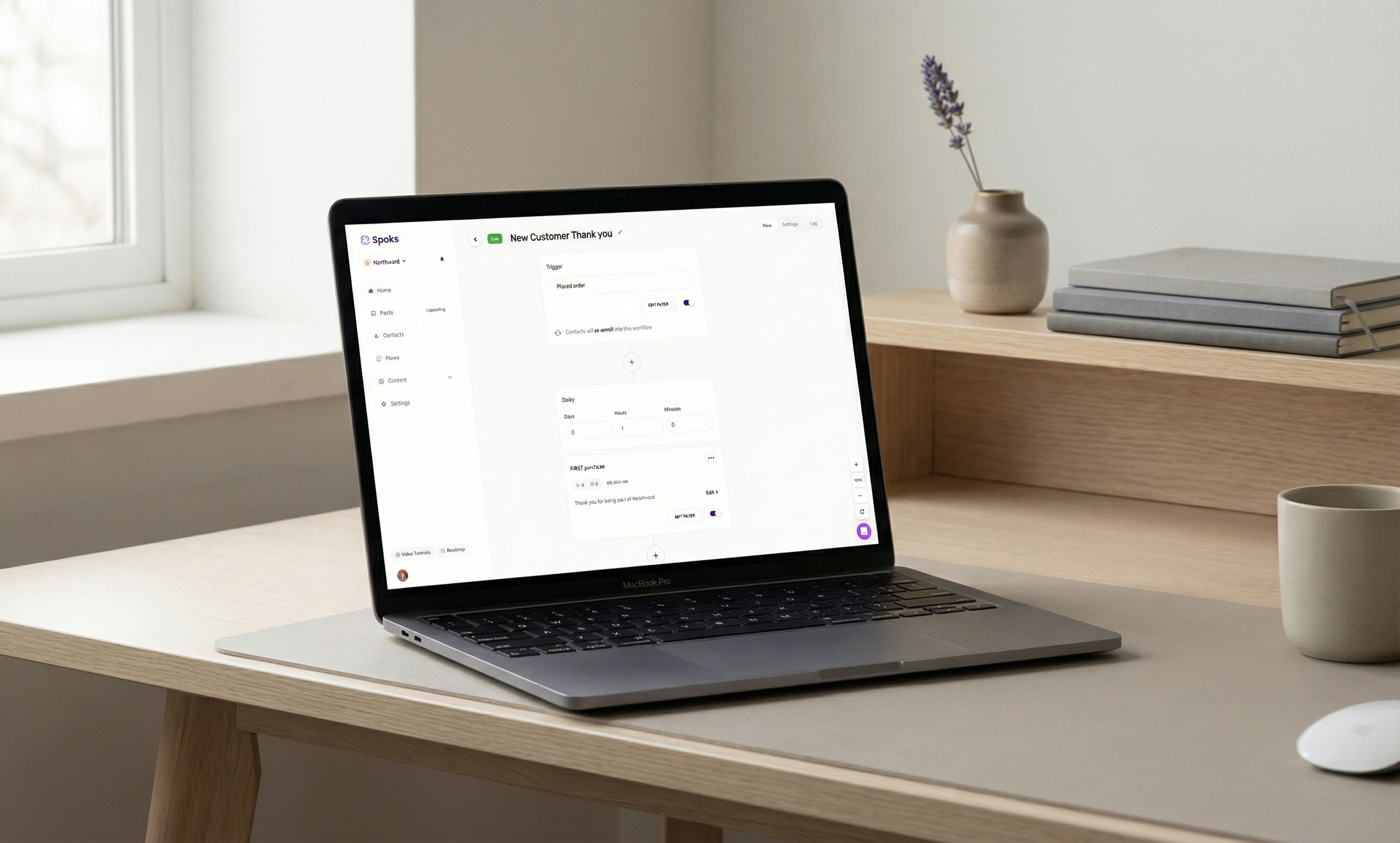
Both Klaviyo and Mailchimp have the same fundamental problem for growing Shopify stores: pricing that scales with your contact list. Add 10,000 subscribers and your bill jumps — regardless of whether those contacts drive revenue. Spoks was built as a direct response to this model: flat $35/month pricing with unlimited contacts, purpose-built for Shopify. If you're tired of watching your email marketing bill climb every quarter, it's worth seeing how Spoks compares to Klaviyo or checking the full list of Klaviyo alternatives for Shopify.
FAQ: Klaviyo vs Mailchimp
Is Klaviyo better than Mailchimp for Shopify?
For most Shopify stores, yes. Klaviyo's Shopify integration is deeper, its automations are more e-commerce-specific, and its analytics provide insights that Mailchimp simply doesn't offer. The only scenario where Mailchimp wins for a Shopify store is when budget is the top priority and you only need basic email campaigns without advanced automation or segmentation.
Is Mailchimp or Klaviyo cheaper?
Mailchimp is cheaper at every contact tier. At 500 contacts, Mailchimp Standard costs roughly $13/month compared to Klaviyo's $20/month. At 25,000 contacts, the gap widens to about $130/month ($270 vs $400). However, Mailchimp locks many advanced features behind its Premium plan ($350+/month), which can eliminate the savings if you need those capabilities.
Can I switch from Mailchimp to Klaviyo?
Yes, and Klaviyo provides migration guides and support for moving from Mailchimp. You can export your subscriber lists from Mailchimp as CSV files and import them into Klaviyo. Segments and tags transfer with some manual work. Automations need to be rebuilt from scratch since the flow builders are completely different. Most stores complete the migration in a few days to a week depending on complexity.
Why did Mailchimp and Shopify break up?
In 2019, Mailchimp refused to comply with Shopify's updated partner program requirements around data handling and customer data ownership. Shopify removed Mailchimp from its App Store, forcing merchants to use third-party connectors or switch platforms. Mailchimp and Shopify reconnected in 2022, but the three-year gap meant Mailchimp's integration missed significant development time while competitors like Klaviyo deepened their Shopify capabilities.
Does Mailchimp work with Shopify in 2026?
Yes. Mailchimp's official Shopify integration has been back in the Shopify App Store since 2022. It syncs customer data, order history, and products. However, the integration is not as deep as Klaviyo's — it lacks Shopify Flow support, predictive analytics on purchase data, and granular on-site behavior tracking. For basic email marketing needs, it works fine. For advanced e-commerce automation, you'll feel the limitations.
Which has better deliverability, Klaviyo or Mailchimp?
Both platforms maintain strong deliverability rates when used with proper list hygiene and authentication. Mailchimp has historically had a slight advantage in raw deliverability scores due to its massive sending volume and long-standing ISP relationships. Klaviyo offers dedicated IP options on higher plans. For most Shopify stores, the deliverability difference is negligible — your sending practices matter far more than which platform you use.
Is Klaviyo worth the extra cost over Mailchimp?
If you're a Shopify store doing $30K+/month in revenue and email drives a meaningful portion of sales, Klaviyo's advanced features (predictive analytics, deep Shopify integration, sophisticated automations) typically generate enough incremental revenue to justify the higher price. If you're a smaller store running basic campaigns and simple automations, the extra cost likely isn't worth it. Our guide to the best email marketing platforms for Shopify covers more options at every price point.
Final Verdict: Klaviyo vs Mailchimp for Shopify
Choose Klaviyo if you're serious about email as a revenue channel for your Shopify store. The deeper Shopify integration, superior automation capabilities, and predictive analytics make it the stronger e-commerce platform — and the one that will grow with your business.
Choose Mailchimp if email is a secondary channel for your business, you need a polished email builder at the lowest possible price, and your automations are simple enough that Shopify integration depth doesn't matter.
Consider neither if you want flat pricing that doesn't punish you for growing your list, and you'd rather invest your savings into actual marketing spend.
The real question isn't which platform has more features. It's which one will drive the most revenue per dollar spent. For Shopify stores that lean on email marketing, Klaviyo wins that calculation — unless the pricing at your contact count pushes you to look at what else is out there.